Inside Costco – No Membership Required

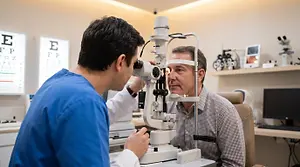
Macular Degeneration Information
What Is Macular Degeneration?
There are various types of macular degeneration. However, the most common form is associated with aging — this eye disease is also called age-related macular degeneration (ARMD or AMD).
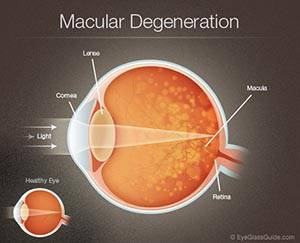
Macular degeneration is an age-related condition in which the most sensitive part of the retina, called the macula, starts to break down and lose its ability to create clear visual images.
The main symptom of Macular Degeneration is slowly losing vision in the central part of sight. This loss precludes the ability to do many everyday activities, including reading and driving. It also reduces your ability to see intricate details such as small prints and patterns.
The leading cause of vision loss in older Americans, 60 and older, is ARMD. Both forms of this disease — wet macular degeneration and dry macular degeneration — affect the central portion of the retina, which is the light-sensitive section located in the back of the eye. This part of the eye processes images and is essentially responsible for sight. The dry form of ARMD is more common than the wet form. In fact, almost 90% of ARMD is the dry form.
Macular Degeneration Diagram
AMD Statistics & Risk Factors
The leading cause of losing vision in people over 60 years of age is macular degeneration. There are various risk factors, including smoking, obesity, and exposure to UV rays. Caucasians are at a significantly greater risk for contracting ARMD than African Americans. Additionally, macular degeneration affects women in greater numbers than men, and has a genetic component.
Key risk factors include:
- Age: Risk increases significantly after age 60
- Smoking: Smokers are two to four times more likely to develop AMD
- Obesity: Being significantly overweight increases the risk of AMD progressing to advanced stages
- Race: Caucasians are at significantly greater risk than African Americans
- Family history: AMD has a strong genetic component — having a close relative with AMD raises your risk
- Gender: Women are more likely to develop AMD than men
- UV exposure: Prolonged exposure to sunlight and UV rays increases risk
- Cardiovascular disease: Heart disease and high blood pressure are linked to increased AMD risk
Forms of Macular Degeneration
Dry Macular Degeneration
Dry macular degeneration is the more common form, accounting for approximately 90% of all AMD cases. It occurs when tiny deposits called drusen form under the macula, causing it to thin and dry out.
Symptoms of dry AMD include:
- Consistent, slightly blurred vision within your central visual field
- Difficulty recognizing faces
- A sudden need for more light while reading or working
- Colors may appear less bright or vivid
- Gradual loss of central vision in one or both eyes
The dry form of this disease gets progressively worse over time. Nutritional supplements (AREDS formula) may help slow its progression.
Wet Macular Degeneration
Wet macular degeneration is a more advanced and severe form of the disease. It occurs when abnormal blood vessels grow underneath the macula and leak blood or fluid, causing rapid and severe central vision loss.
Symptoms of wet AMD include:
- A distortion of straight lines (they may appear wavy or bent)
- An inability to focus properly on a single point within a grid
- Blind spots in the central vision
- Loss of centralized vision
- Colors may appear washed out
- Rapid deterioration of central vision
Wet macular degeneration is an advanced stage of the disease and often results in blind spots and loss of centralized vision. While more serious, it is also more treatable with modern anti-VEGF injection therapies.
Symptoms of Macular Degeneration
Macular degeneration symptoms vary based on the particular form of the disease (dry or wet), and the stage the disease is at the time it is discovered. Common warning signs include:
- Gradual loss of central vision in one or both eyes
- Distorted, blurry, or fuzzy vision
- Straight lines appear wavy or bent (a classic sign of wet AMD)
- Difficulty seeing fine details — such as small print — even with glasses
- A dark, blurry, or blank area in the center of vision
- Colors appear less bright or vivid than they used to
- A sudden need for more light when reading or doing close work
- Difficulty recognizing familiar faces
In the early stages, macular degeneration may not cause any noticeable vision changes. Regular comprehensive eye exams are the best way to detect AMD early, before significant vision loss occurs.
Diagnosing Macular Degeneration
Early detection is the key to managing macular degeneration effectively. Your eye doctor can diagnose AMD during a comprehensive eye exam using several tests:
- Visual acuity test: Measures how well you see at various distances
- Dilated eye exam: Your doctor uses drops to widen your pupils and examines the retina and macula for signs of drusen deposits or damage
- Amsler grid test: A simple test using a grid of straight lines — if the lines appear wavy or missing, it may indicate AMD
- Optical coherence tomography (OCT): High-resolution imaging of the retina to detect fluid, drusen, or other changes beneath the macula
- Fluorescein angiography: A dye-based test that reveals leaking blood vessels characteristic of wet AMD
Regular comprehensive eye exams are highly recommended — especially for individuals over 60, or those with a family history of AMD.
Schedule a Comprehensive Eye Exam
At MSP Eye Associates, our doctors perform thorough comprehensive eye exams that include screening for macular degeneration and other serious eye conditions. Early detection gives you the best chance of preserving your vision.
We serve patients at two convenient locations in the Minneapolis–St. Paul metro area. Contact us today to schedule an appointment.
Treatment Options for Macular Degeneration
There is as yet no outright cure for macular degeneration, but some treatments may delay its progression or even improve vision. Treatment options vary depending on the type and stage of AMD.
AREDS Vitamins & Supplements
The Age-Related Eye Disease Study (AREDS) found that high-dose vitamins and mineral supplements — including vitamins C and E, lutein/zeaxanthin, zinc, and copper — can reduce the risk of AMD progressing to an advanced stage by about 25%.
The updated AREDS2 formula recommends lutein and zeaxanthin over beta-carotene (especially for smokers). These supplements are most effective for people with intermediate AMD or advanced AMD in one eye, and are not intended to prevent the onset of AMD.
Anti-VEGF Injections
Anti-VEGF (vascular endothelial growth factor) therapy is the primary treatment for wet AMD. Medications such as ranibizumab (Lucentis), bevacizumab (Avastin), and aflibercept (Eylea) are injected directly into the eye.
These drugs block the growth of abnormal blood vessels under the macula and can prevent further vision loss. In some cases, they can significantly improve vision. Most patients require ongoing injections — often monthly or every few months — to maintain the benefit.
Anti-VEGF therapy has revolutionized the treatment of wet AMD and can help preserve and sometimes restore central vision.
Low Vision Aids & Rehabilitation
For patients with significant vision loss from AMD, low vision aids and rehabilitation services can help maximize remaining vision and improve quality of life.
Low vision aids include:
- Magnifying glasses and handheld magnifiers
- Telescopic lenses and bioptic telescopes
- Electronic magnification devices (video magnifiers / CCTVs)
- Large-print books, publications, and keyboards
- Talking clocks, phones, and other adaptive devices
- Computer software and smartphone apps designed for low vision
Low vision rehabilitation specialists can provide training on using these devices and teach strategies for performing everyday tasks more safely and independently.
Can Macular Degeneration Be Prevented?
While there is no guaranteed way to prevent AMD, several lifestyle choices can significantly reduce your risk or slow its progression:
- Don't smoke — smoking is one of the strongest modifiable risk factors for AMD
- Eat a healthy diet rich in leafy green vegetables, fish, and foods containing antioxidants
- Maintain a healthy weight and exercise regularly
- Wear UV-protective sunglasses outdoors to reduce sun damage to your retina
- Control blood pressure and cholesterol — cardiovascular health is linked to eye health
- Get regular comprehensive eye exams — early detection is critical for preserving vision
Talk to your eye doctor about your personal risk factors and what steps you can take to protect your vision.
Concerned About Your Vision? Schedule an Eye Exam Today
If you are over 60, have a family history of AMD, or are experiencing any changes in your central vision, do not wait to seek care. Early diagnosis and treatment can make a significant difference in preserving your sight. Our experienced eye care team is ready to help — with convenient locations in Woodbury and Rochester, Minnesota.